One Track, Three Listens: A Quiet Listening Session
A three-pass listening session helps you hear how a song’s sections, repeated patterns and ending work together, without turning attention into a performance review.
The most common mistake in a quiet listening session is trying to hear everything at once; the cost is a track that passes as one dense impression. A three-pass listening session gives each return a distinct question, so you can notice how a song’s sections, repeated patterns and ending relate. You are not grading the singer, the mix or your own concentration. You are giving the music room to disclose its shape.
Choose a track you can play from beginning to end without interruption. A familiar song offers a known outline; an unfamiliar one lets you encounter its structure as it unfolds. Use the same recording for all three passes, and keep a phone or notebook nearby only if notes help you listen. Ordinary headphones or speakers are enough.
A three-pass listening session moves from shape to pattern
Each pass narrows the question. First, follow the song’s sections and transitions. Next, listen for a pattern that returns. Finally, consider how the ending changes your sense of what came before. The movement is like reading a short story once for its turns, then noticing a recurring image, then asking what the last line does to the opening.
This is not a hunt for a single correct interpretation. It is a way to make listening active without making it evaluative. If your attention wanders, return to the current question rather than restarting the track or scolding yourself.
The first pass follows sections and transitions
Let the track play without pausing. Notice where a section seems to begin or end, whether the musical material returns, and how one passage gives way to another. You need not name formal labels such as verse, chorus or bridge. Attend instead to contrast: does a new section feel more open, more crowded, quieter, or more insistent?
Afterwards, write a few plain words about the route. Perhaps the opening idea returns after a contrasting passage, or the song keeps moving forward without a clear return. Describe what you heard rather than whether it succeeded. If the arrangement stays steady, note that too: continuity is part of its shape.
The second pass listens for a returning pattern
Choose a pattern that seems to recur across the track. It might be a short melodic phrase, a repeated word, a rhythmic figure, a particular change in texture, or a pause that appears at similar points. Listen for what stays recognisable and what changes around it. The pattern may connect separate sections or make a later return feel different from its first appearance.
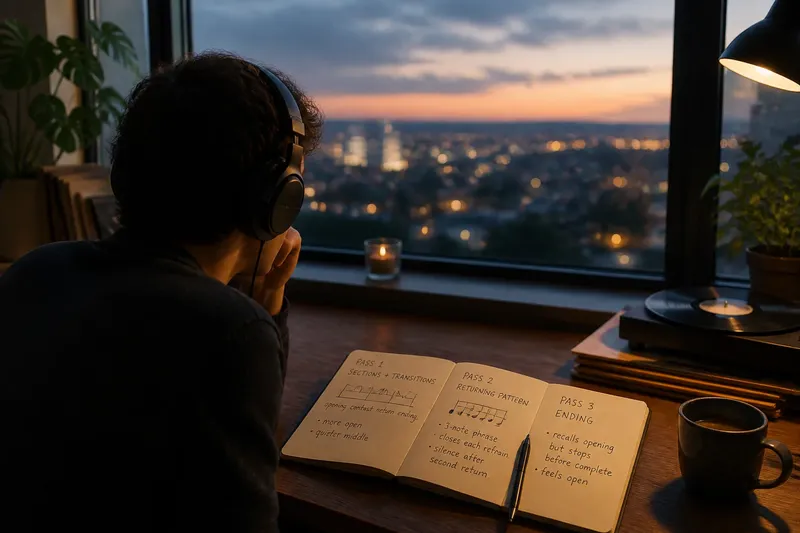
Say you choose an invented song whose first pass suggests that the chorus returns twice. On the second pass, you follow a three-note phrase at the end of each chorus: the first time it leads into a new verse, and the second time it is followed by a brief silence before the final section. You note that the repeated phrase links the choruses, while the silence makes the later return feel less settled. Those are observations about this imagined track, not rules for hearing every song.
If no pattern stands out, follow a repeated section instead. Compare its position and surrounding material, without assuming that each recurrence must carry a deliberate message. A repeated passage can provide familiarity, contrast or simply a stable point in the song.
The third pass considers what the ending changes
Let the whole track play again, with attention on its final passage and the route into it. Does the ending repeat an earlier idea, introduce something new, or stop before a pattern feels complete? Notice whether its character makes the opening seem like preparation, a contrast, or an event in its own right.
Keep your response provisional. An ending may feel conclusive because musical material returns, or open because the track leaves a question unresolved; neither impression needs to be defended as the one true meaning. If a short section is hard to remember, replay it once after the full pass, provided doing so does not interrupt the song’s flow for you.
It can help to locate a detail in ordinary language, such as “the refrain after the quiet middle section” or “the final return of the opening phrase”. A location gives you something concrete to revisit without turning the session into a search for technical curiosities.
Brief notes keep the listening specific
A useful record can fit in a note on your phone or a few lines on paper. Keep it descriptive and brief. For example:
- Sections: opening idea, contrasting middle, opening idea returns.
- Pattern: the same three-note phrase closes each refrain.
- Change: the later phrase is followed by silence instead of another section straight away.
- Ending: the final passage recalls the opening but stops before it feels complete.
These are prompts, not required categories. If writing pulls you out of the music, leave the notebook closed until the track ends. A note should help you remember what caught your ear, not compete with the sound.
What should you choose and how should you listen?
Should the track be familiar?
Choose a familiar song if you want to compare its returns with an outline you already know. Choose an unfamiliar one if you would rather discover its sections as they arrive.
Do you need special headphones or speakers?
No particular equipment is required for this session. Use a setup that lets you hear comfortably, and keep the same recording for each pass so your attention stays on the music.
Is it all right to pause between listens?
Yes. A brief pause can help you set aside one question before taking up the next; playing the passes consecutively can make the song’s returns easier to compare. Choose the rhythm that keeps your attention unforced.
What if the sections do not seem clear?
Listen for contrasts in texture, repeated material or a change in momentum rather than searching for formal labels. If the track remains consistent, note that continuity and consider how its ending relates to the pattern you heard.
Let one observation carry into the next listen
After the third pass, take a moment before playing anything else. Read your notes, if you made them, and ask whether a recurring pattern or the ending has changed your sense of the song’s route. You do not have to settle on an interpretation; a useful result may simply be knowing what you want to hear again.
For a first three-pass listening session, choose a song with sections or repeated material you can recognise without effort. The method works best when each return gives you a fresh question, and its most useful record may be one precise observation that stays in your ear after the music stops.