Piano or Guitar for Hearing Chord Changes?
Piano or guitar for hearing chord changes? Compare their layouts, sound and playing feel to choose the instrument that makes harmony easier to recognise.
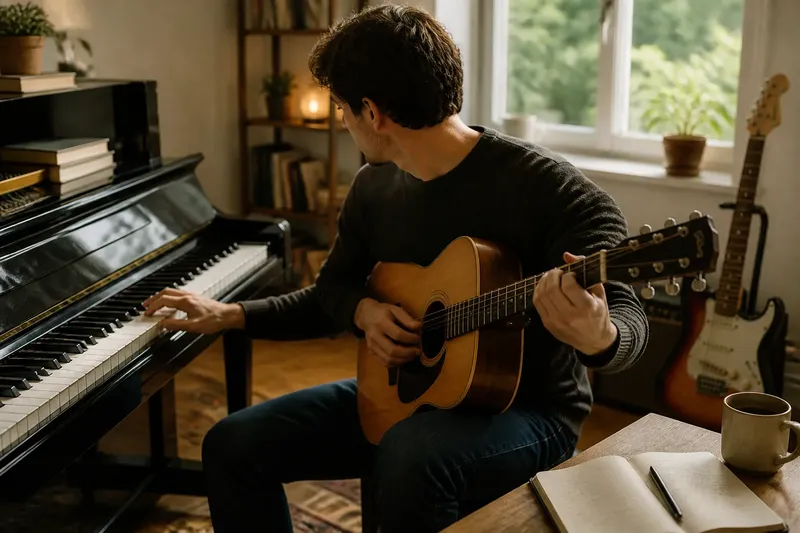
The common mistake when choosing piano or guitar for hearing chord changes is to assume the instrument with the easier chord shape will make harmony clearer. That can leave you watching your hands instead of hearing the music. The useful distinction is what each instrument lets you inspect: piano separates pitches across a keyboard, while guitar connects them through strings, fingerings and rhythmic gestures.
Piano separates chord tones across a keyboard
On a piano, pitches rise from left to right. A chord sounds several keys together, and their positions make intervals visible: you can see which notes sit close together and which are farther apart. The repeating pattern of black and white keys also helps locate the same named note in different octaves.
This layout is helpful when you want to compare the notes that make up two chords. You can play their tones one at a time, then together, and listen for how the combined sound changes. It is also straightforward to rearrange the same notes into a different order, making chord inversions easier to inspect.
The keyboard can make every note seem equally important, especially when a chord is spread across several octaves. To hear its foundation, play or listen to the lowest note separately before sounding the full chord. That gives you a clearer sense of the relationship between the bass note and the tones above it.
Guitar connects harmony to strings and playing gestures
A guitar distributes pitches across six strings, and some notes can be played in more than one position. Chord shapes give the fretting hand a physical pattern to remember. If you already play songs by strumming, that familiar movement can help you recognise when the harmony shifts.
Open strings may continue ringing as you change chords, creating a smooth connection between them. A finger can also stay in place while the others move. These features make guitar useful for hearing how a progression flows, though sustained strings can blur the exact point where one chord gives way to another.
Guitar is less direct when you want to inspect every note in a chord. The pitches may be spread across strings in an order that does not resemble a simple stack, and different fingerings can produce the same chord. A capo changes the sounding pitches while preserving familiar shapes, which is convenient for playing but can make pitch relationships less obvious.
Match the instrument to the detail you want to hear
- If individual chord tones are hard to distinguish, choose piano. Play the notes separately, then together; if their relationship becomes clearer, continue comparing chords on the keyboard. If the layout distracts you, listen to the notes one at a time without looking at your hands.
- If you lose the rhythm of a progression, choose guitar. Strum the chords in a steady pattern; if the change becomes easier to feel, keep the pulse as you listen. If ringing strings blur the transition, mute them before changing chords.
- If inversions are confusing, start at piano. Rearrange the same chord tones in a different order; if the change in sound is clear, compare that order with the next chord. If naming the notes gets in the way, focus on whether the chord feels higher or lower.
- If a chord sounds familiar but you cannot recall its shape, use guitar. Try the fingering you know; if it brings the harmony into focus, use it to follow the song. If the capo makes the pitch unclear, remove it or check the sounding notes on a keyboard.
- If you already know one instrument well, begin there. Play a short progression you recognise; if you can attend to the harmony, stay with it. If hand movements take too much attention, switch to the instrument whose layout feels more familiar.
- If you want to compare two chords directly, use whichever instrument lets you play them cleanly. Sound each chord at the same pace; if the difference is audible, repeat while attending to one feature. If technique interrupts the comparison, simplify the fingering or play the notes separately.
Think of piano as a set of labelled drawers and guitar as a row of interlocking handles. The drawers make individual contents easier to locate; the handles show how one movement connects to another. Neither picture is complete, but each can make a different musical detail easier to notice.
Which instrument answers common listening questions?
Which instrument makes chord tones easiest to identify?
Piano is often the more direct starting point because each key has a fixed place on the keyboard. On guitar, the same pitch may be available on different strings, so its location can be less obvious.
Which instrument is clearer for chord inversions?
Piano makes it easy to rearrange the notes of a chord and compare their order. Guitar can play inversions too, but alternate fingerings and string positions may take more attention to interpret.
Can guitar make a chord change easier to hear?
Yes, particularly if rhythm and a familiar strumming pattern help you follow a song. If the chord change is masked by open strings, mute them briefly or listen for the new strum rather than trying to identify every pitch.
Do you need chord names to hear a change?
No. You can begin by noticing whether the harmony sounds more settled, tense, bright or dark. Chord names can organise those impressions later, but they are not needed to recognise that something has changed.
Let the listening question guide your choice
Say you can follow a melody but lose the harmony when a singer holds a note. Imagine, as an invented example, that the two chords are C major and A minor, played as C–E–G and A–C–E. At a piano, play the first chord, then the second, keeping C and E in the same octave while changing G to A; the result should make the altered top tone easier to hear. On guitar, play familiar open shapes for C major and A minor with a steady down-strum; the trade-off is that a ringing high E continues through both chords, while the bass changes from C to A. If the sustained melody still draws your attention away, play the chords more slowly or sound their notes separately.
For hearing chord changes, piano offers a clearer view of how pitches are arranged, while guitar brings chord shapes and rhythmic flow into the foreground. The main phrase, piano or guitar for hearing chord changes, comes down to which feature you want to follow: individual notes or the gesture of the progression. Start with a short passage you know, and let the instrument make that particular question easier to hear.